
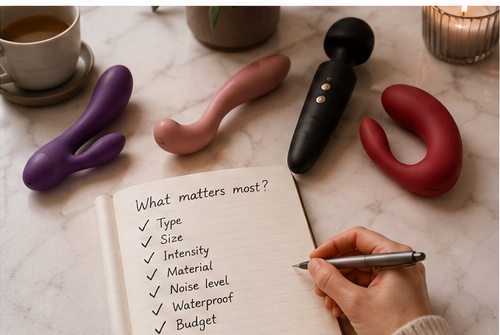
There is no single intimate product that works for everyone.
People have different preferences, different comfort levels and different reasons for shopping. A product that one person considers perfect may be completely unsuitable for someone else.
That’s why choosing the right product is less about finding the product with the longest feature list and more about matching the product to your needs.
First Ask: What Are You Looking For?
Before comparing products, identify the experience you’re looking for.
Are you interested in:
- External stimulation?
- Internal stimulation?
- A combination?
- Massage?
- Solo use?
- Couples’ use?
- Something compact and discreet?
- Something with adjustable intensity?
You don’t need to have a perfectly defined answer.
Even identifying what you don’t want can eliminate many unsuitable choices.
Understand Different Product Designs
Product shapes aren’t purely decorative. Different shapes are intended to provide different types of stimulation and handling.
Some designs are compact and targeted.
Others have elongated or curved forms.
Some are designed specifically for couples.
Others are intended for external use.
Some products combine more than one function.
When comparing products, don’t simply ask what the product looks like. Ask:
What is this shape designed to accomplish?
That question makes product comparison much easier.
External or Internal?
This is one of the first distinctions to consider.
External products are generally used on the outside of the body.
Internal products are designed for insertion and therefore require additional consideration around size, shape, comfort and safe use.
If you’re new to intimate products, you may prefer starting with something that feels straightforward and manageable.
There is no requirement to progress from one type to another.
Choose what suits you.
Consider Size and Shape
Size should always be considered in relation to intended use.
Look at:
- Length
- Diameter
- Overall shape
- Curvature
- Weight
- Grip
- Flexible versus firm construction
A larger product isn’t necessarily better.
A smaller product isn’t necessarily more beginner-friendly either.
What matters is whether the dimensions and design are appropriate for your comfort level and intended use.
Intensity and Controls
Some products provide a single operating mode.
Others offer multiple intensity levels and patterns.
If you’re new to these products, adjustable intensity can give you more control because you can start gently and adjust according to your preference.
But again, more settings aren’t automatically better.
A product with six understandable settings can be more useful than one with twenty complicated patterns.
Materials and Construction
Material is one of the most important specifications to examine.
Clearly identified, non-porous materials such as silicone, glass and stainless steel are commonly used because they can be relatively straightforward to clean when properly cared for.
Other materials can have different care requirements.
Don’t rely solely on colour, texture or how soft a product looks in a photograph.
Check the actual material specification.
Also look at the construction. Seams, joints, charging ports and moving parts can influence cleaning and maintenance.
Noise Level
For many people, discretion is an important part of choosing an intimate product.
Noise can vary depending on the product, motor and operating mode.
If you live with family, roommates or a partner and privacy matters to you, consider looking for products where the manufacturer provides information about operating noise.
A quieter design may provide more confidence in everyday use.
Waterproofing and Water Resistance
Water resistance can make cleaning considerably easier, but the terminology matters.
There is a difference between a product that is merely resistant to splashes and one that is designed for immersion.
Always follow the manufacturer’s instructions.
If the product has a charging port or electronic components, don’t assume it can be submerged.
When in doubt, treat electronics conservatively and clean them according to the manufacturer’s instructions.
Power and Charging
Think about how you’ll actually use the product.
Battery-operated products can be convenient because you can replace batteries quickly.
Rechargeable products can be convenient for regular use and eliminate the need for replacement batteries.
Consider:
- Charging method
- Charging time
- Battery life
- Availability of replacement batteries
- Whether the charging connection needs special care
A feature is only useful if it fits your routine.
Solo or Couples?
Your intended use can substantially narrow the choices.
Some products are designed for individual use.
Others are specifically designed to be incorporated into partnered intimacy.
If you’re buying for couples, consider whether both partners can comfortably use or control the product.
If you’re buying for yourself, focus on the design and features that matter to you rather than choosing something simply because it is marketed as a couples’ product.
Don’t Buy Based on Trends
Online shopping can create a strange effect where a product becomes popular simply because everyone is talking about it.
That doesn’t make it the right choice for you.
Reviews can be useful, but read them carefully.
Look for comments about:
- Comfort
- Ease of use
- Battery life
- Noise
- Cleaning
- Durability
- Actual size
- Quality of construction
Try to separate genuine product feedback from comments that are simply about expectations.
What Should Beginners Prioritize?
If you’re new to intimate products, a sensible priority order is:
1. Comfort
2. Appropriate design
3. Clear material information
4. Easy controls
5. Easy cleaning
6. Suitable size
7. Useful features
8. Price
This doesn’t mean price isn’t important.
It means price shouldn’t be considered in isolation.
A Product Doesn’t Need to Do Everything
One common shopping mistake is looking for a single product that offers every possible feature.
That often results in a complicated product that isn’t particularly good at the thing you actually wanted.
Specialized products can sometimes provide a better experience than “does-everything” designs.
Think about the experience first.
Then choose the tool.
Final Takeaway
Choosing the right intimate product is ultimately a matching exercise.
Match the product to your comfort, intended use, preferences, experience level, material requirements, desired features and budget.
Don’t buy simply because something is expensive, popular or heavily advertised.
The right product is the one that fits you.